
What is an AI capability platform?
An AI capability platform builds, coaches, and measures what people can do with AI at work.
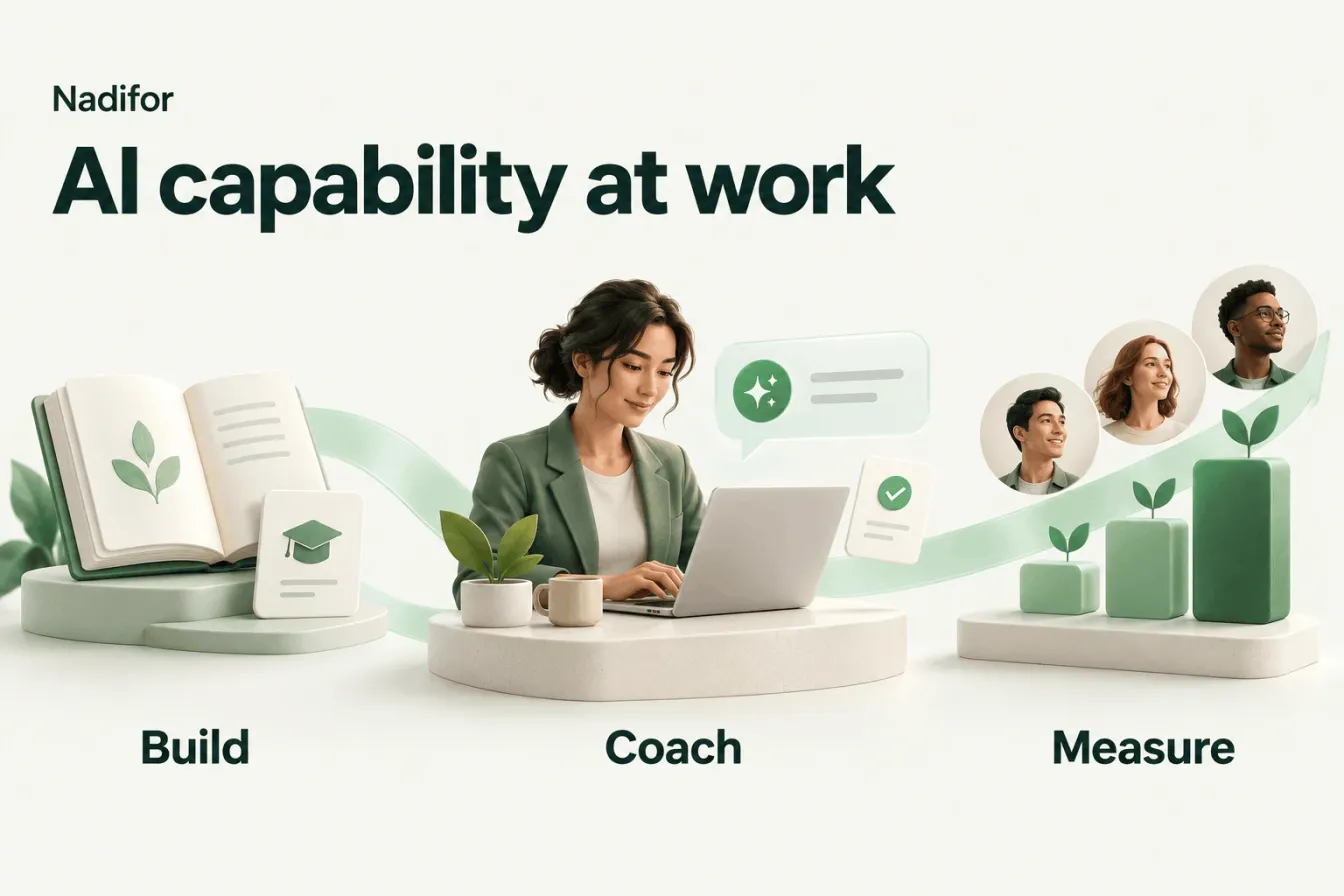
An AI capability platform is software that helps an organisation build, coach and measure what people can do with AI in their actual work. Unlike systems centred on course completion or content discovery, it connects structured development with practice, in-work coaching and evidence of capability at team level over time. See the capability platform glossary.
What problem does an AI capability platform solve?
Most workplace learning systems can tell you who enrolled, what they completed, and which content they accessed. Those records are useful, but they do not tell you whether somebody can apply what they learned when the work requires it.
That gap becomes more visible with AI. Someone may understand how a tool works and still struggle to decide when to use it, how to brief it, whether an output is reliable or where human judgement still matters.
MIT NANDA’s 2025 State of AI in Business report found a wider gap between enterprise GenAI experimentation and measurable business impact. Its analysis linked stalled deployments in part to tools and organisations that do not learn, adapt or integrate, including weak feedback and memory loops.
Nadifor uses the learning gap for a related people-development problem: the distance between what somebody learns and what they can do afterwards in their work. See the learning gap glossary.
What is an AI capability platform, and how is it different from an LMS or LXP?
An AI capability platform builds, coaches, and measures what people can do with AI in their actual work. An LMS tracks course completions. An LXP recommends content. A capability platform combines structured learning with an AI coach inside real tasks and tracks capability per team over time, so an organisation can show what changed, not only who finished.
| LMS | LXP | AI capability platform | |
|---|---|---|---|
| What it typically tracks | Enrolment, completion, certification and learning records | Content use, engagement, recommendations and learning activity | Applied capability and how it changes over time |
| Where development happens | Mainly through managed courses and programmes | Across curated and aggregated learning content | Through structured development, practice and support connected to work |
| Primary focus | Managing and recording formal learning | Helping people find and access learning | Building and measuring what people can do |
| Role of coaching | Varies by platform | Varies by platform | Coaching connected to applying development in work |
| What it helps prove | That required learning was completed | That people found and used relevant learning | Whether capability developed beyond completion |
The categories overlap in places. An LMS can include assessments. An LXP can include skills data. The clearer distinction is the question each system is built to answer.
What is a capability academy, and how does it relate?
A capability academy organises development around an important organisational capability rather than around a catalogue of courses.
Josh Bersin popularised the term in 2019, describing a capability academy as an environment where people build job-related capabilities through learning, expertise, practice, projects and experience.
A capability platform can provide part of the infrastructure behind that approach, including development, coaching and measurement. The academy itself is broader than the technology.
Capability vs skills vs competency: what do the words mean?
These terms are often used interchangeably, but they describe different levels of performance.
| Term | Practical meaning | Example in AI at work |
|---|---|---|
| Skill | A specific ability that can be learned and practised | Writing a clear instruction for an AI system |
| Competency | Knowledge, skills and behaviours associated with effective performance in a role | Using AI appropriately as part of a defined job |
| Capability | The ability to bring skills, knowledge, judgement and experience together in context | Deciding when and how to use AI on a real task, evaluating the result and acting on it appropriately |
Different organisations define these terms in slightly different ways. For a capability platform, the important part is application. Knowing a technique matters less if the person cannot use it effectively when the situation demands it.
What does an AI capability platform measure?
An AI capability platform should measure change in applied capability, not only activity inside the platform. That means establishing a baseline, assessing what people can do, tracking development over time at team level, and connecting development with the work people perform. Completion can still be recorded, but it is not the final measure.
A capability scale gives the organisation a consistent reference point before and after development.
Nadifor’s capability scale is adapted from the AI Fluency Framework, developed by Rick Dakan and Joseph Feller with Anthropic. The framework defines AI fluency through four competencies: Delegation, Description, Discernment, and Diligence.
Adapted from the AI Fluency Framework by Rick Dakan, Joseph Feller, and Anthropic, used under CC BY-NC-SA 4.0.
Used consistently, a scale can show where capability is developing across a team and where people still need support. That is more useful than treating a completed course as the end of the development process.
Who buys an AI capability platform, and why?
Typical buyers include Heads of L&D, Heads of Transformation and People leaders responsible for developing AI capability across an organisation.
Their problem is rarely a lack of training content. More often, they need to know whether development is relevant to different roles and whether people can apply it afterwards.
This becomes harder when AI development has to reach teams doing very different work. Finance, legal, operations and management may all need AI capability, but they do not need the same practice or the same level of depth.
Do we still need an LMS if we buy a capability platform?
Most organisations keep their LMS when they add a capability platform. The LMS stays the system of record for mandatory training and certificates. The capability platform does a different job: it coaches people inside real work and measures capability per team. Over time, some teams retire the LMS, but that is a later decision, not a condition of starting.
An existing LMS may continue to do a useful job. The decision becomes easier when each system has a clear purpose: formal learning records, content discovery, capability development, coaching, or evidence of progress.
How do you evaluate an AI capability platform?
Start with what you need to understand about your workforce and the work people need to perform better.
- Role relevance: Can development reflect what different people actually do?
- Application: Do people get opportunities to practise in work, rather than only consume content?
- Coaching: Can support use relevant context about the person’s role and development needs?
- Measurement: Can you establish a baseline and track capability consistently over time?
- Evidence: Can L&D and business leaders see more than participation and completion?
- Existing systems: Can the platform sit alongside an LMS or LXP where those systems still have a useful role?
- Governance: Can the provider give clear, evidenced answers about security, data, and the integrations you require?
A useful evaluation starts with one capability that matters. Define what better performance would look like, then test whether the platform can support people towards it and show whether anything changed.
Frequently asked questions
What is an AI capability platform?
An AI capability platform helps organisations develop and measure what people can do with AI in their work. It combines structured development with practice, coaching connected to real tasks, and capability measurement over time. Its focus is applied capability rather than learning activity alone, so organisations can understand what changed after development took place.
How is a capability platform different from an LMS?
An LMS is primarily designed to manage, deliver and record formal learning, including enrolments, completions and certificates. A capability platform focuses on what happens afterwards: whether people can apply what they learned, how capability changes over time and where teams may need further development or support.
Is a capability platform the same as an LXP?
No. An LXP usually helps people discover and access relevant learning from different sources. A capability platform is organised around developing and measuring capability. Some functionality may overlap, but recommending content and showing whether somebody can apply what they learned are different jobs.
What is a capability academy?
A capability academy is a structured way to develop an organisational capability through learning, expertise, practice, projects and experience. Josh Bersin popularised the term in corporate L&D in 2019. It describes a broader development model rather than a particular software category or individual learning product.
What does capability mean compared with skills?
A skill is a specific ability, such as carrying out a particular task. Capability describes whether somebody can bring relevant skills, knowledge, judgement and experience together in context. This is why capability cannot be understood from course completion or possession of an isolated skill alone.
Who uses an AI capability platform?
AI capability platforms matter to organisations developing AI capability across multiple roles or teams. L&D and transformation leaders can use them to structure development and track progress, while employees use learning, practice, and coaching connected to the work they actually do.
Do we need to replace our LMS?
Not necessarily. An LMS can remain useful for formal or mandatory learning while a capability platform supports development closer to work and measures capability over time. Organisations can use both systems together and review the wider learning stack later, once each system’s role is clear.
What should a capability platform measure?
It should measure whether capability is changing, not simply whether learning activity took place. Useful evidence includes a baseline, later assessments, and changes at team level over time. The measures themselves should reflect the capability being developed and the work in which people are expected to apply it.