
AI coach inside real work
An AI coach that works inside real tasks, shows people a better way as they work, and feeds capability tracking per team.
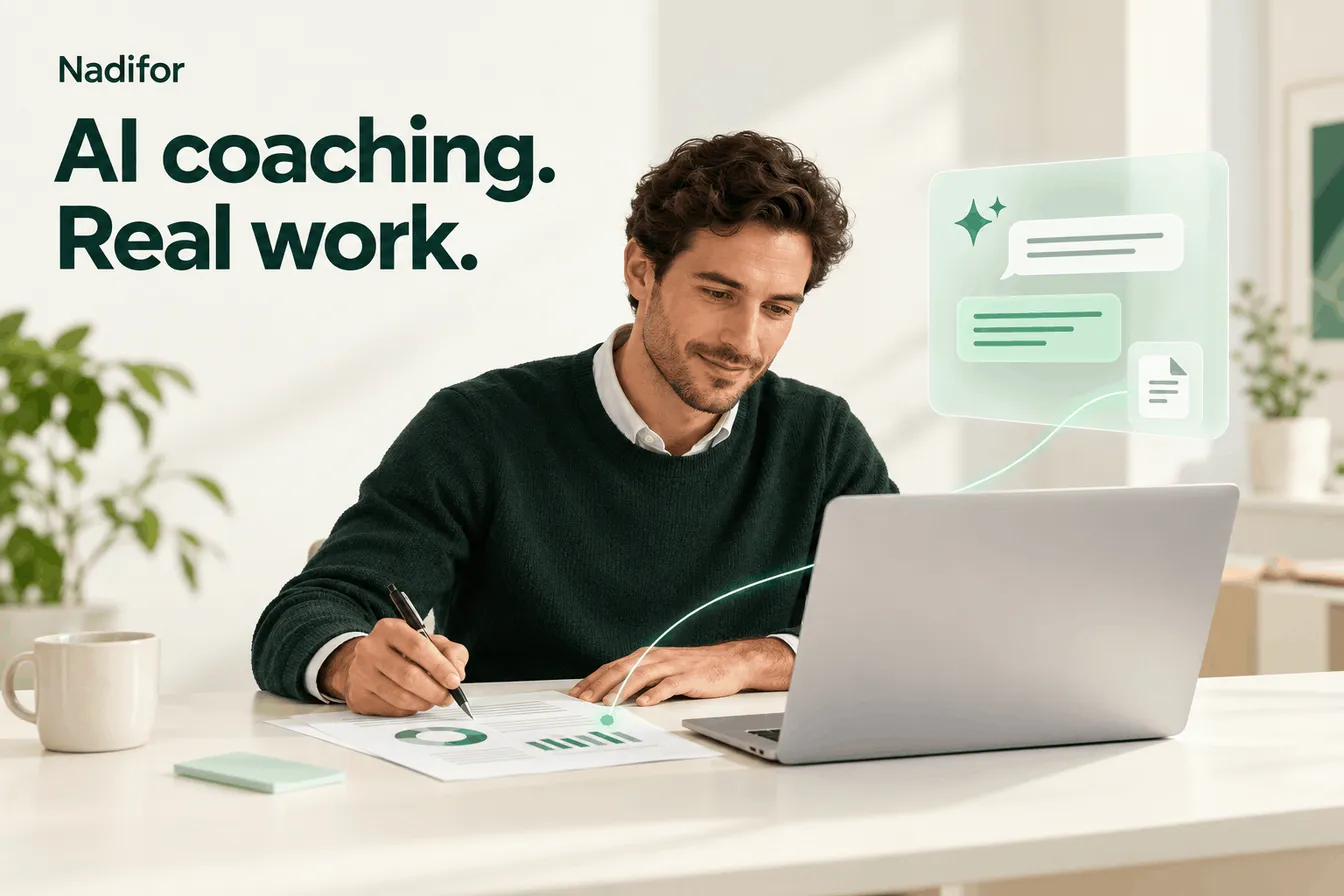
Nadifor’s AI coach helps employees develop while they work on real tasks. It uses context about the person’s role, work, feedback, and development priorities to make coaching relevant to what they need to do next. It sits within the wider Nadifor platform, alongside learning, practice and capability tracking.
What is the AI coach?
The AI coach provides personalised development around the work an employee actually does. It can use context about the person’s role, current work, feedback and development priorities to make practice and coaching more relevant.
A course can give someone useful knowledge in advance. The difficulty often comes later, when they need to apply it to a particular situation. Coaching closer to the work can support that moment.
How does coaching inside real work differ from a course?
A course usually has a defined beginning and end. Employees learn something, complete it, and return to their jobs.
Real situations are less tidy. A manager may understand the principles of giving feedback and still find one conversation difficult. An analyst may know how to use generative AI but need to make better decisions about a specific piece of work.
Coaching can respond to those moments without replacing structured learning. Learning provides foundations. Practice and coaching help people apply them in context.
What does a coaching moment look like?
A lawyer working on a draft
A lawyer wants to use AI while preparing a draft. The useful coaching is not another introduction to generative AI. It can focus on the task in front of them: how to approach the work, which parts require judgement, and what they need to consider before relying on an output.
An analyst summarising a report
An analyst has to turn a long report into a useful summary. Coaching can help them think about structure, identify what matters, assess the quality of the output and decide where their own judgement is needed. The lesson can then carry into the next similar piece of work.
A manager preparing feedback
A manager has a difficult feedback conversation coming up. They may know the theory already. What they need is space to think through this conversation, practise how they will explain the issue and consider how the other person may receive it.
How does AI coaching feed capability tracking?
Coaching sits inside a wider development cycle. People work on a capability, practise it, apply it, and continue developing as their role changes.
Nadifor connects that development with capability tracking over time, so L&D and People teams can see where teams are progressing and where more support may be useful.
The coach can also sit alongside an organisation-wide AI literacy programme where AI capability is being developed across the workforce.
What is the AI coach not?
It is not intended to be a generic chatbot attached to a learning platform. Its role is employee development connected to work and development context.
It is also not presented as a replacement for human coaching. Some development depends on human judgement, trust, and relationships. AI coaching gives employees another source of support closer to everyday work.
Frequently asked questions
Is the AI coach a chatbot?
The AI coach uses conversational AI, but its purpose is employee development. It uses relevant context such as role, work, feedback, and development priorities to support practice and coaching connected to the person’s job, rather than functioning as a general-purpose question-and-answer tool.
Which tasks does it coach?
The coach can support development around tasks where an employee needs to practise, reflect, or improve how they work. The relevant task depends on the person’s role and priorities. Examples include preparing feedback, approaching analytical work or improving how AI is used within a real work task.